
Los Cabos Real Estate Market Interpretations
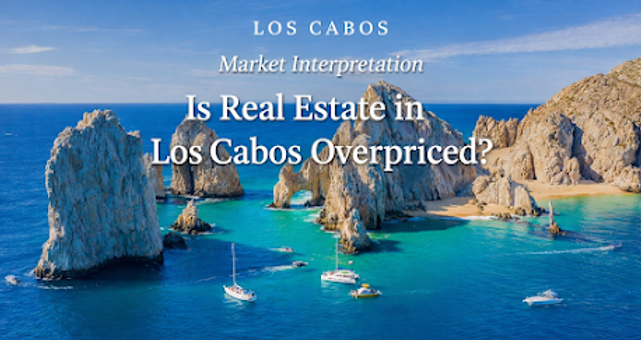
Is Real Estate in Los Cabos Overpriced?
Short answer: No — but it isn’t cheap anymore.
Los Cabos has changed. What was once a seasonal destination has become a place people actually live, invest, and return to long term. Prices didn’t rise overnight — they evolved with demand, infrastructure, and global interest.
Los Cabos is often discussed as if it were a single market. It is not.
It is made up of dozens of micro-markets, each behaving differently depending on location quality, infrastructure maturity, buyer profile, and long-term usability. As a result, broad statements about pricing often miss where value exists — and where it doesn’t.
The question of whether Los Cabos is “overpriced” is usually framed too simply.
What often gets missed in this conversation:
Los Cabos is not one market — it’s dozens of micro-markets
Some areas are priced aggressively, others remain aligned with value
Construction and replacement costs are now very high
Buyers today are lifestyle-driven, not speculative
Well-located properties continue to move — even in slower cycles
Understanding these distinctions matters more than reacting to headline pricing.

The analysis presented in this report reflects structural observations within the Los Cabos real estate market and assumes several baseline conditions that influence pricing behavior across the region.
Market Scope
This interpretation primarily reflects the core Los Cabos residential ecosystem, including Cabo San Lucas, the Tourist Corridor, Pedregal, Marina districts, and San José del Cabo. These areas represent the highest concentration of residential demand, infrastructure investment, and international buyer participation.
Micro-Market Structure
Los Cabos is not a single unified market. Pricing behavior varies significantly across micro-locations depending on infrastructure maturity, proximity to lifestyle hubs, ocean views, community positioning, and long-term usability. As a result, property values should be evaluated within their specific submarket rather than through regional averages.
Buyer Profile
The majority of buyers entering the Los Cabos market are lifestyle-oriented purchasers seeking long-term ownership, seasonal use, or partial rental income rather than short-term speculation. This behavior tends to stabilize pricing during market transitions.
Capital Composition
A large portion of transactions in the Los Cabos luxury segment occur with limited leverage or cash purchases. Because of this, price movements are influenced less by interest rate cycles than in heavily mortgage-driven markets.
Replacement Cost Environment
Construction costs in Baja California Sur have increased materially due to labor availability, logistics, materials, and regulatory timelines. These higher replacement costs increasingly support valuations for completed properties in prime locations.
Infrastructure and Destination Maturity
Los Cabos has experienced sustained investment in hospitality, aviation connectivity, luxury development, and lifestyle infrastructure. These long-term structural improvements continue to influence global demand for residential property within the region.
Market Interpretation Disclaimer
This report provides strategic market context and structural observations. It is not an appraisal, valuation guarantee, or investment recommendation, but rather a framework designed to help buyers and sellers better understand the dynamics shaping the Los Cabos property market.
Is everything worth the asking price? No.
Is the entire market inflated? Also no.
Some segments are priced optimistically. Others are supported by location quality, replacement cost, buyer depth, and long-term demand. Pricing outcomes diverge because underlying structures differ.
Several structural signals currently influence pricing behavior across the Los Cabos real estate market. These signals help explain why some areas command premium pricing while others remain more value-aligned.
Los Cabos Has Transitioned From Seasonal Destination to Residential Market
Historically, Los Cabos functioned primarily as a seasonal tourism destination. Today it operates as a hybrid lifestyle market where many buyers maintain long-term residences, remote work arrangements, or multi-month occupancy.
This shift has deepened demand for residential property beyond traditional vacation ownership.
Micro-Markets Drive Pricing Divergence
Price performance varies significantly across neighborhoods and development zones. Areas with established infrastructure, strong community identity, and ocean-view positioning tend to command scarcity premiums.
Other emerging districts may still offer value opportunities relative to their long-term development trajectory.
Construction Costs Support Replacement Value
Building a comparable home today often costs significantly more than the original construction price of many existing properties.
Higher construction costs — including materials, labor, and permitting timelines — increasingly reinforce the value of completed homes in prime locations.
Lifestyle Demand Remains the Dominant Driver
Unlike highly speculative markets, Los Cabos buyers tend to purchase property for lifestyle reasons:
• Personal use and seasonal residency
• Long-term second homes
• Family ownership across generations
• Hybrid lifestyle and remote work
Lifestyle-driven demand tends to produce more stable long-term market behavior.
Scarcity Locations Continue to Command Premiums
Certain districts within Los Cabos continue to maintain structural scarcity due to geography and zoning limitations.
Examples include:
• Pedregal hillside positioning
• Marina-adjacent locations
• Select Corridor oceanfront communities
• Established luxury residential enclaves
Properties in these areas often maintain stronger pricing resilience compared with broader market averages.
Pricing Sentiment and Market Reality Are Often Misaligned
Public conversations frequently frame Los Cabos real estate as either “cheap” or “overpriced.” In reality, the market contains a wide range of pricing behaviors depending on micro-location, property type, and buyer profile.
Understanding these structural distinctions is far more important than reacting to headline price comparisons.

Los Cabos isn’t expensive because it’s fragile.
It’s expensive because it matured.
Mature markets do not correct evenly, and they do not reward blanket assumptions. They reward buyers who understand structure, context, and behavior.
Buyers who focus solely on whether prices are “high” risk missing where value actually resides.
Those who understand micro-markets, replacement economics, and buyer behavior are better positioned to protect capital and preserve flexibility over time.
Structural Framework Connection
Guidance for discerning buyers navigating Los Cabos luxury market

Zon Murray has spent over four decades living along the Baja coastline, with firsthand experience of how the Pacific and the Sea of Cortez behave across different seasons, conditions, and locations.
From surf breaks to swimmable beaches, each stretch of coastline offers a distinct environment — shaped by wind, swell, and exposure — often in ways that are not immediately visible.
This perspective provides a clearer understanding of how each beach functions day-to-day, and how that translates into lifestyle, access, and long-term real estate value.
Through Cabo Coastal, this insight is refined and structured, with transactions executed through Diamante Realtors.