
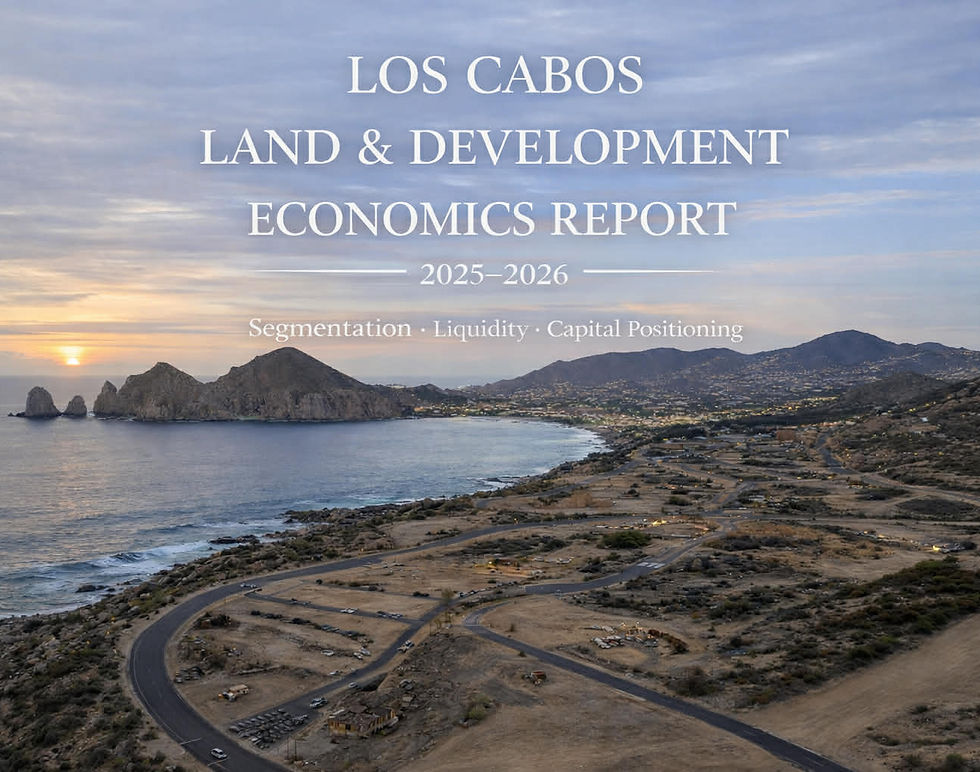
2025 Los Cabos Land & Development Economics Report
Zoning, Density, Replacement Cost & Capital Deployment Across Baja California Sur
Central Thesis
The 2025 Los Cabos land market did not contract — it recalibrated.
Developer underwriting discipline increased.
Capital deployment slowed selectively.
Replacement-cost logic tightened.
Land value in Los Cabos is no longer speculative momentum — it is feasibility-driven.
The cycle rewards zoning precision, infrastructure certainty, and exit clarity.
Executive Overview
Throughout 2025, land transactions across Los Cabos and Baja California Sur reflected a shift from speculative acquisition toward structured underwriting.
Key themes included:
Slower absorption of large parcels
Increased sensitivity to infrastructure timelines
Stricter feasibility modeling
Focus on density optimization rather than land banking
In high-demand corridors (Cabo Corridor, San José del Cabo fringe, select East Cape beachfront), land values remained supported.
However, generic inland parcels without infrastructure clarity experienced extended marketing timelines and reduced leverage.
The market segmented between:
• Developable land with immediate feasibility
• Long-horizon land dependent on future infrastructure
Regional Breakdown
Cabo Corridor
High-density, oceanview parcels with approved zoning retain strong positioning.
View-protected land commands a premium.
Speculative inland parcels face negotiation pressure.
San José del Cabo Fringe
Growth corridors continue to attract medium-density residential development.
Infrastructure proximity defines performance.
East Cape
Prime beachfront land remains scarce and strategically important.
Generic inland acreage trades slower.
Future infrastructure will determine long-term revaluation.
Pacific Side / Todos Santos
Boutique architectural development drives smaller parcel demand.
Large-scale speculative land faces longer absorption horizons.
Seller Perspective: Why Developers Discount Homes
Long-term homeowners often expect valuation based on emotional investment and renovation cost.
Developers evaluate differently:
They calculate:
• Demolition cost
• Density yield
• Build cost
• Exit pricing
• IRR threshold
If the existing structure reduces development yield, it reduces land value in their model.
This is economic logic — not disrespect.
Understanding this distinction improves negotiation outcomes.
Inventory Absorption
Land inventory across Los Cabos expanded in visibility during 2025, particularly in mid-sized development parcels, inland subdivision land, and expansion-zone acreage. However, the increase in listings did not equate to an increase in fully entitled, infrastructure-ready supply.
The majority of new inventory required:
• Zoning clarification
• Infrastructure extension
• Environmental approvals
• Capital-intensive entitlement processes
Absorption slowed selectively as developers tightened underwriting standards. Due diligence periods extended, and speculative land banking declined.
Prime parcels with:
• Clear density allowances
• Infrastructure access
• Defined exit pricing
continued to transact.
Generic or infrastructure-dependent land experienced extended marketing timelines and greater negotiation flexibility.
Adjustment occurred primarily through slower absorption — not broad-based price collapse.
This reflects a feasibility-filtered land market rather than a distressed one.
If you want it even tighter (more executive tone), here’s a shorter version:
Inventory & Absorption
Inventory expanded primarily in non-prime categories during 2025, while fully entitled, infrastructure-ready land remained limited.
Absorption slowed as developers increased underwriting discipline and extended due diligence timelines.
Prime parcels continued to transact. Speculative or entitlement-dependent land faced extended marketing periods.
The land cycle is filtering capital — not collapsing in value.
Pricing Resilience
Land pricing across Los Cabos in 2025 demonstrated resilience in prime, entitlement-clear segments while softening selectively in speculative categories.
There was no broad-based repricing across core coastal zones. Instead, adjustment occurred through:
• Extended marketing timelines
• Increased negotiation flexibility
• Greater developer discount expectations
• Stricter feasibility thresholds
Prime land — defined by view protection, zoning clarity, infrastructure access, and realistic exit pricing — retained strategic value.
In contrast, parcels dependent on:
• Future zoning changes
• Uncertain infrastructure timelines
• Aggressive forward pricing assumptions
faced pricing pressure as developers recalibrated internal rate of return (IRR) models.
Importantly, land pricing is derivative of construction feasibility.
As hard costs remain elevated, residual land values must align with build economics. Where exit pricing supports development yield, land retains strength. Where it does not, pricing compresses.
This segmentation reflects disciplined capital filtering rather than systemic distress.
Structural constraints — coastal geography, limited oceanview topography, and sustained lifestyle migration — continue to support long-term land value in core corridors.
The 2025 land market did not collapse.
It recalibrated around feasibility logic.
Forward Outlook
The most probable 2026 trajectory:
• Continued disciplined land acquisition
• Selective high-density approvals
• Focus on mid-scale luxury projects
• Infrastructure-sensitive capital deployment
• Wider valuation spread between prime and generic land
A macro shock could freeze land liquidity temporarily, as land is typically first to slow in uncertain cycles.
However, structural coastal scarcity remains a long-term support variable.
Capital Perspective
The prior cycle rewarded early land positioning and forward pricing assumptions.
The current cycle rewards:
• Entitlement clarity
• Infrastructure certainty
• Density optimization
• Construction cost discipline
• Exit audience definition
Land in Los Cabos remains strategically important.
But land is no longer speculative momentum.
It is feasibility-driven capital deployment.
In 2026, disciplined developers will outperform aggressive land bankers.
Methodology
This report synthesizes 2025 transaction behavior, regional brokerage observations, zoning considerations, construction cost trends, and development feasibility dynamics across Los Cabos and Baja California Sur.
All commentary reflects independent advisory interpretation and does not reproduce proprietary development models.

